Before word games lived on every phone, PopCap Bookworm had millions of people hunting for words on a grid of letter tiles. Here’s the full story of the original game: who built it, how it played, the records it set, why it vanished from stores in 2016, and what options are left if you want to play it today.
What Was PopCap Bookworm?
PopCap Bookworm is a word-forming puzzle game first released on February 25, 2003. You get a grid of letter tiles, link touching letters into English words, and feed those words to a hungry worm. Each word disappears, new tiles drop in from the top, and the cycle repeats until the board turns against you.
It sounds simple, and that was the point. PopCap built its name on casual games that took seconds to learn, and the bookworm game PopCap launched in 2003 fit that formula perfectly. It ran in a web browser, needed no manual, and could swallow an entire lunch break without anyone noticing.
Lex the Bookworm and the Letter Grid
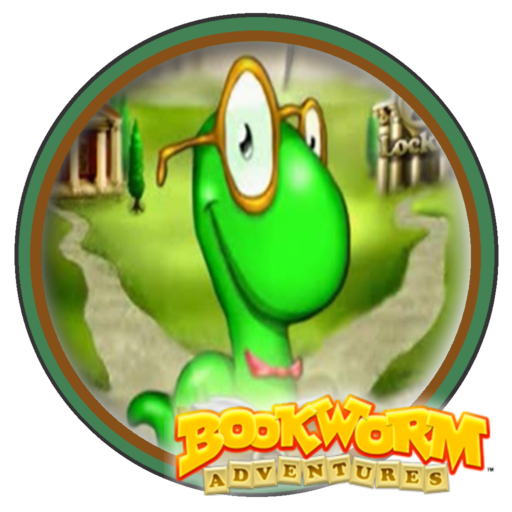
The star of the show is Lex, a green worm with glasses and a red bowtie who sits beside the board. In the first game he’s mostly just called “Bookworm.” His name got far more attention later, in the Bookworm Adventures series.
Lex is more than decoration. Click him and he scrambles every tile on the board, which can rescue a dead grid. The catch is that a scramble brings in a wave of burning tiles, so it’s a last resort rather than a free reset.
In the Deluxe edition, Lex also pops up with dictionary definitions for some of the words you play. It’s a small touch, but it made PopCap Bookworm feel quietly educational without ever turning into homework.
Bookworm Deluxe and Its Release Date
The free web version lived on PopCap’s site and partner portals, while the paid “Deluxe” download added sharper graphics, a timed Action mode, and a Hall of Fame for top scores and best words. PopCap’s own pages were already promoting those Deluxe extras by early 2004.
If you’re looking up the Bookworm Deluxe release date, you’ll find several answers. Some catalogs list a March 2006 PC release, and Steam added Bookworm Deluxe on August 30, 2006. The mix-up comes from the game being reissued through different stores, so 2003 remains the true starting point for PopCap Bookworm.
Who Created the Original Bookworm Game?
Jason Kapalka and the Early PopCap Team
The original Bookworm game was designed by Jason Kapalka, one of PopCap’s three co-founders. Before becoming a game developer, Kapalka was a games journalist at TEN, the Total Entertainment Network, which later became Pogo.com. There he met John Vechey and Brian Fiete, two young programmers from Indiana whose online game ARC had been picked up by TEN.
The three founded PopCap Games in 2000, at first working out of their own apartments. Kapalka became the studio’s chief game designer, and his fingerprints are on much of its early catalog. PopCap Bookworm shows his style clearly: one clean idea, a friendly mascot, and enough depth to keep good players chasing higher scores.
Where Bookworm Fits Among PopCap Games
Bookworm arrived between two much bigger names. Bejeweled had launched in 2001 and turned the young company into a casual-gaming success story. Plants vs. Zombies would follow in 2009 and become its best-known franchise.
PopCap Bookworm sat comfortably in the middle. It never chased the flashy combos of Bejeweled, but it gave word lovers something those games didn’t: a reason to dig through their vocabulary. For players who preferred spelling to matching gems, the PopCap Games Bookworm page was the main reason to visit the site.
How PopCap Bookworm Plays
The rules of PopCap Bookworm fit in a sentence: connect adjacent letters, in any direction, to spell a real word. Longer words score more, and rare letters such as Q, X, and Z are worth more than common vowels. The game also uses a combined “Qu” tile, which saves you from hunting for a lonely U.
That simplicity hides real strategy, which is why PopCap Bookworm rewards patience as much as vocabulary.
Burning Tiles and Bonus Tiles
Red burning tiles are the main threat in PopCap Bookworm. In Classic mode they creep down one row after each turn, destroying the letters beneath them. If one reaches the bottom and you can’t use it on that turn, the game ends. They appear more often as you climb levels, which steadily raises the pressure.
Good play is rewarded with colored bonus tiles. Long words earn green tiles, and even longer ones bring gold, sapphire, and diamond tiles that boost your score. These special tiles also take longer for fire to burn through, so they double as defensive walls.
Each round also shows a bonus word worth extra points, and every bonus word you find in a game pays more than the last. Some versions hide themed “books” too: groups of words from one category. Spell the first word of a set and the book unlocks, showing the full list you need to complete it.
Classic Mode vs Action Mode
Classic mode has no clock. You can stare at the board as long as you like, and burning tiles only advance when you submit a word. It’s the relaxed way to play PopCap Bookworm and the version most people remember from the free online game.
Action mode, part of the Deluxe edition, takes that comfort away. Burning tiles appear on their own every few seconds, and if one hits the bottom you get about ten seconds to clear it. It turns the same puzzle into a race, and it’s where high-score chasers spent most of their time.
Awards, Records, and Recognition
Computer Gaming World’s Puzzle Game of the Year
The critics noticed quickly. Computer Gaming World named PopCap Bookworm its Puzzle Game of the Year for 2003. The magazine’s editors praised PopCap for turning easy-to-learn pieces into something players couldn’t put down, and they joked that it beat many big-budget releases of the same year at holding attention.
The award put PopCap Bookworm in the same conversation as boxed retail games, and it helped convince many PC gamers that “casual” didn’t have to mean shallow.
A Guinness World Record for Downloads
The bigger recognition came later. In June 2010, Guinness World Records named PopCap Bookworm the most downloaded word puzzle game, with more than 100 million downloads. A few years earlier, in 2007, the American Library Association had given Bookworm Deluxe its Notable Computer Software for Children award.
That mix says a lot about the game’s reach. Hardcore critics, record keepers, and librarians all liked the same retro game, which is rare. PopCap Bookworm managed it by being fun first and educational second, never the other way around.
Sequels, EA, and the 2016 Delisting
Bookworm Adventures and Bookworm Heroes
PopCap expanded the series in November 2006 with Bookworm Adventures, which turned word-building into turn-based combat. Lex traveled through famous stories and myths, and every word you spelled damaged an enemy. It won Downloadable Game of the Year at the 2007 Interactive Achievement Awards, and Bookworm Adventures Volume 2 followed in July 2009.
The last new entry was Bookworm Heroes, an iOS game released in April 2013. The game shut down on December 1, 2014, and no new Bookworm title has appeared since.
The EA Era and the 2016 Removal
Electronic Arts bought PopCap Games in 2011 in a deal worth about $750 million up front. Plants vs. Zombies and Bejeweled carried on under EA, but the PopCap Bookworm series went quiet.
Then, between April and May 2016, Bookworm Deluxe and both Bookworm Adventures games were pulled from digital stores, including Steam, EA’s Origin, and Pogo. Neither PopCap nor EA gave a public explanation. Because the games disappeared even from EA’s own platforms, many fans suspect an expired license, but that has never been confirmed.
Is Bookworm Still Available Today?
This is the question most people searching for PopCap Bookworm actually want answered. The honest answer: not through any official store. EA support staff have told players on the company’s forums that the game was delisted years ago and can no longer be purchased. If your old install is stuck at the 60-minute trial, there’s no way to buy an unlock code today.
MSN Games, Pogo, and Free Web Versions
For years, the free bookworm game PopCap offered was easy to find. The web version ran on PopCap’s own site, and portals like MSN Games and Pogo hosted it for millions of casual players. MSN Games Bookworm and Pogo Bookworm were many people’s first taste of the game.
Those days are mostly over. Pogo dropped the game during the 2016 delisting, and older browser-plugin games faded as browsers stopped supporting them. Some game portals still claim to offer PopCap Bookworm, but many of those pages don’t load a working game at all.
Legal Ways to Play the Bookworm Original
If you want the Bookworm original today, physical media is the most reliable legal route. Boxed PC copies of Bookworm Deluxe, including PopCap compilation discs, still turn up secondhand. If you already own the game through an EA account or a CD key, you can still install and play it.
The original game also exists on Game Boy Advance and Nintendo DS cartridges. Its DSiWare release outlived the PC version for years, but Nintendo closed the 3DS eShop to new purchases in 2023. Fan resources such as a Bookworm Deluxe wiki can help you work out which discs and versions are worth hunting down.
Whatever route you take, be careful with unknown download sites. Scan any installer before running it, skip anything that asks for unusual permissions, and remember that PopCap Bookworm was built for Windows XP-era machines, so modern systems may need compatibility settings.
FAQ
Who made the PopCap Bookworm game?
PopCap Bookworm was designed by Jason Kapalka, who co-founded PopCap Games with John Vechey and Brian Fiete in 2000. PopCap developed and published the original 2003 release, while Black Lantern Studios handled the later Nintendo DS and DSiWare versions. Kapalka also worked on many other early PopCap games as the studio’s chief designer.
When was Bookworm Deluxe released?
The original PopCap Bookworm launched on February 25, 2003, and PopCap sold a paid Deluxe download with extra modes soon after. Many store listings date Bookworm Deluxe to March 2006, and it arrived on Steam on August 30, 2006. Dates differ because the game was reissued through several storefronts over the years.
Is Bookworm still available to buy?
No official store sells PopCap Bookworm today. Bookworm Deluxe and the Bookworm Adventures games were delisted from Steam, Origin, and Pogo between April and May 2016. Owners with a CD key or an EA account copy can still play, and secondhand discs and Nintendo DS cartridges remain the main legal options.
Why was PopCap Bookworm removed from stores?
Neither PopCap nor Electronic Arts has publicly explained the removal. The games vanished in 2016 even from EA’s own Origin and Pogo services, which suggests a licensing issue rather than a simple business decision. EA kept its Bookworm trademarks active for years afterward, so a return isn’t impossible, but nothing has been announced.
Can I play the original Bookworm free online?
The free bookworm game PopCap once hosted on its own site, MSN Games, and Pogo is no longer officially offered. Some websites still claim to run it, but many don’t load properly. Stick to reputable sites, avoid installers that ask for unusual permissions, and scan any download before opening it.
Final Thoughts on PopCap Bookworm
PopCap Bookworm took a simple idea, spelling words from a grid of letters, and turned it into one of the most played casual games of the 2000s. Jason Kapalka’s design, Lex’s friendly presence, and the tension of burning tiles gave it a staying power few word games have matched. Critics, librarians, and Guinness World Records all recognized it, and Bookworm Adventures carried the idea into new territory.
The story has an awkward ending, though. Since the 2016 delisting, there’s no official way to buy the game, so physical copies and existing licenses are the main paths left. Even so, the original PopCap Bookworm remains a classic PC game worth remembering, and for many players, worth tracking down one more time.